

How I Destroyed the Integrity of Women’s Sport
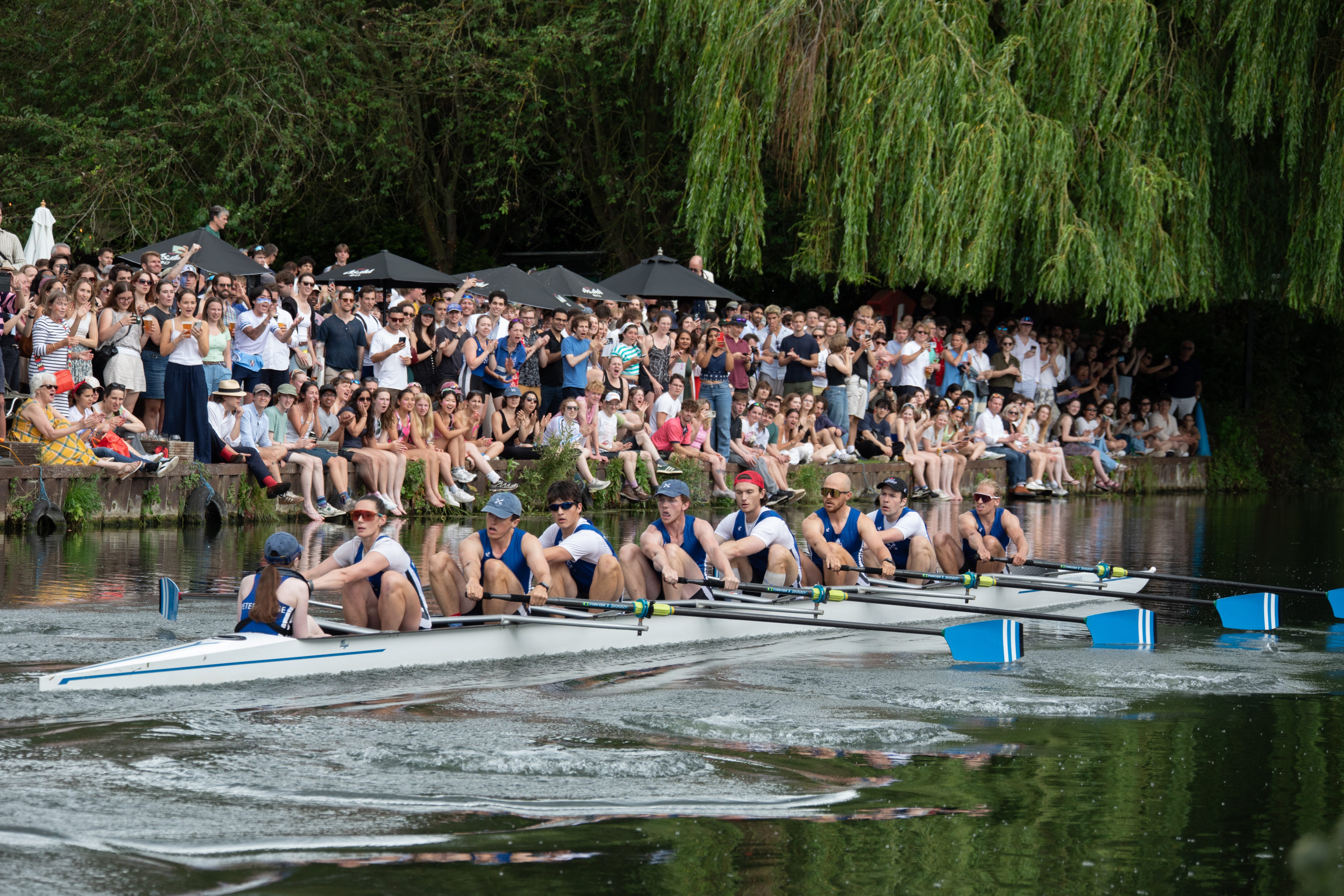
It’s June in Cambridge, England. The sun is at last gracing the meadows, a miracle that does not go unnoticed by anyone in the city limits, perhaps the entire county. Along the shores of the narrow river that winds through the countryside and into the town, students and community members enjoy a drink or two while cheering on the crews from each college as they careen down the river, one after another, with the hope that they will crash into the boat ahead before the boat behind crashes into them. If you were to find yourself part of this melee, there is no doubt that an excitable rower or student would tell you that you are witnessing the annual May Bumps[1].
Looking to make the most out of my Cambridge experience, I suited up in the uniform for my college and hopped into the boat with a few of my fellow collegians and paddled off to the start. After four days of chaos, we finished the racing on top, securing the coveted “Mays” headship for our college for the first time in the boat club’s two-hundred-year history. But let’s face it. This achievement meant a lot to the crew members, the other members of the boat club and college, perhaps even a few alumni, but outside of the bubble of the Cambridge University college rowing scene, hardly anyone pays much attention to the intercollegiate races on the River Cam. Why would this year be any different?
In 2026, the mysterious powers that govern Cambridge college rowing decided to align with British Rowing and introduce an “open” category to replace the “men’s” category in a move touted as being “trans inclusive.” Because of this, I, a cisgender woman, became the first woman to win headship in the men’s (now “open”) event in Cambridge’s history[2]. My choice to participate in the men’s competition drew an astonishing amount controversy for a niche, amateur rowing event. Comments filtered in from various corners of the internet (see the comment section from the articles in The Times and The Wall Street Journal) and rowing community at Cambridge (see nearly 100% of Rowbridge Rewritten Facebook[3] posts from May until July), so now that the dust has settled, I have decided to write down my thoughts on the matter.
There were a couple questions I wrestled with when choosing to do this and when participating, and despite the historical complexity between the personal and political for women, it was simplest to put my reasoning into one of those two categories, and because no one particularly wants to hear my whining about how I, as a world champion rower for the US, feel more pressure to perform and meet certain standards in women’s crews or how I just wanted to have fun with this race, I will keep the personal reasons rather limited in scope for the purposes of this piece. I will note, however, that a big part of the reason that I joined the men’s crew was simply because they asked me to.
The notion of feminism acknowledges that our basic society is founded on an understanding of “man” as the subject or absolute, and woman as “other”[4]. Despite immense and undeniable progress made towards equality between sexes, I argue that, in sport compared to other arenas, this concept is particularly persistent. Sport, which relies heavily on performance by the physical body and less by the mind, emphasizes differences in men and women more so than endeavors such as music, fine arts, Excel spreadsheets, baking cakes, etc. Perhaps this is why we more often see delineations for “female athletes” but not “female violinists” or “female stock analysts.” Or why, as a slight dig at my alma mater, the Instagram handle for the men’s lacrosse team is @princetonlax and the women’s team is @princetonwlax. The list goes on. The point is that women’s sports and the associated athletes are consistently “othered.” By stroking the top men’s eight for my college, I was able to show that men’s sports and women’s sports do not operate in distinct worlds. I do not deny that men in strength-based sports do have a genetic advantage over women, however I firmly reject the idea that all men are inherently better at sports than all women, a notion that is not obvious for far too much of the population. A coach at one of the Cambridge colleges said to my coach, “Why would you put a girl in the stroke seat? She will hold the boys back.” This conversation reflects the prevalence of the antiquated view that grossly over-exaggerates the difference between men’s and women’s sports. One of the reporters for The Times asked me about the difference between men’s and women’s rowing. I noted that men’s boats on average go a bit faster, but the biophysics of what moves the boat is largely the same. That comment didn’t make it into the article.
Many critics argued that elite female athletes joining an “open” category makes women’s sport feel second-class. Some even went so far as to say that my actions “destroyed the integrity of women’s sport.” This attitude assigns far too much importance to a singular amateur rowing race, but extrapolated, the departure of the best women from women’s sport would indeed be an issue. However, it is an issue we need not worry about. Personally, my choice to compete on the men’s side was partially influenced by the opportunity to prove the capability of women in sport in response to the frustration I felt towards my perception of the general attitude towards female athletes, particularly in the UK. If my decision had been solely about where I felt more acceptance, perhaps I would have made a different choice. Sport provides a sense of community, belonging, and identification, which is why the cultivation of women’s sport is so important for the development of young women and elite athletes alike. Women will on aggregate chose to compete in the categories in which they find more connection with their peers. In some sports, men and women compete together (equestrian, archery, etc.), and in other sports women are superior (extreme endurance sports), but for most disciplines, there is a difference between men and women at the elite level.[5] While it is possible for me to compete in amateur sport against male athletes with a lesser degree of experience than myself, I am not ashamed to say that I would fare far worse in competition with elite male athletes. My case was unique because I actually had a better chance of winning on the open side than the women’s side.[6] I’ll also add that the seven other members of the crew were well above the standard of many of the other crews competing.
Furthermore, women cannot hope to enjoy true freedom without the freedom to make their own choices. Roxane Gay argues that because we live in an imperfect system and we ourselves are imperfect as individuals, it is at once possible to promote the ideals of feminism while accepting or even enjoying aspects of society that contradict modern feminism. A modern woman can and should enjoy the autonomy associated with a class not “othered.”[7] This has two direct correlations to my own activities: the first is that in a perfect world, female athletes would not feel the need to prove their worth in relation to male athletes. The media attention garnered from my participation demonstrates that our cultural norms haven’t yet caught up with the reality of what female athletes can accomplish. The second is that, given that the category is “open,” female athletes should be able to choose the division in which they compete for any reason that resonates. Though all choices have consequences, modern feminism would reject the haranguing of women based on how they choose to interact with an inherently gendered world.
Lastly, and I will keep this short and sweet because there is nothing I can add to this discussion that hasn’t already been said by someone more qualified: the fact that, for this event, a woman was able to win the men’s category shows that gender was not the most important factor here. And, I’ll add that an “open” category and a “women’s” category is not “trans inclusive,” as the event organizers claimed. One trans woman, who was a member of a women’s only college was forced to compete for an entirely different college in a men’s boat due to the policy. Forcing women, regardless of their gender assigned at birth, to compete in a primarily men’s category can hardly be described as inclusive.
I had a great sense of satisfaction in proving wrong many of the antiquated perspectives strutting around Cambridge and in disobeying the umpire who said he’d rather see women not row at all than row in the open category. I was proud to meet a member of the 1956 crew, who as a nonagenarian was excited about the progress made in the event, and I was happy that the members of the college boat club, both men and women, were wholeheartedly supportive. Most importantly, our crew had a lot of fun, and isn’t that the point?
[1] The May Bumps, along with the May Balls, another Cambridge tradition both occur at the end of June. And I know what you’re thinking. It makes absolutely zero sense.
[2] I have been excessively reminded that in the occasion that a college cannot field a full boat for either gender, women may have competed in their college’s top male boat. The Cambridge University Boat Club fielded a boat of women that competed in the men’s novice category before a women’s category existed. Caryn Davies won headship in Oxford’s version of the event in 2015.
[3] A very tragic corner of the internet where disgruntled rowers post anonymously about anything from crews not following the correct traffic pattern to their secret crushes on the river.
[4] Stealing from de Beauvoir here, naturally
[5] This is relative to my own experience, and I’ll leave the conversation surrounding trans athletes to someone more qualified. I should also add that the difference between men and women at the elite level varies immensely between sports.
[6] The race has a hereditary structure. Your starting position each year is determined by your college’s finishing position the previous year. For my college, the men’s boat was starting second whereas the women’s boat was starting towards the bottom of the field.
[7] Paraphrasing here
I adore this
I’ve competed in Sailing (obviously different sport) with mixed teams and all women’s teams and all but me men’s teams Great article and mixed is the best in my sport. Thanks for writing.